Thursday, November 02, 2006

Petroglyph digitization: enabling cultural heritage scholarship

George V. Landon and W. Brent Seales, “Petroglyph digitization: enabling cultural heritage scholarship,” Machine Vision and Applications, vol. 17, no. 6, pp. 361–371, December 2006.

Abstract:
The digitization of antiquities is facilitating a renaissance for scholars who have unprecedented access to rich representations of objects. Cultural Heritage digitization is a central challenge, and its subtleties are intertwined with object properties and the constraints of physical access and handling. In this paper, we present the design and analysis of a system built for the digitization of Puerto Rican petroglyphic iconography. The petroglyphs exhibit unique properties (shape, size, surface) that determine system design choices. The 3D models obtained with the system support new scholarly and educational activities, including interactive surface lighting, feature highlighting and annotation through mark-up, and immersive viewing using large-scale displays.

Available Online

Friday, September 22, 2006

Computer Science & Illusion

As noted on Robert Burke's blog, Trinity College Dublin (TCD) recently hosted a great lecture by Prof. Andrew Blake. He really runs the gambit on topics in computer vision covering various theories and applications.


Part 1:


Part 2:


If you prefer not to stream: Full Movie Download (118MB WMV).
Also, the PowerPoint slides are available (44MB ZIPPED PPT).

Monday, September 18, 2006

Is Computer Science losing its coolness?

The Seattle Times has just run an interesting story, titled Where'd The Whiz Kids Go?, on the lack of CS students in Washington Universities. It seems that this is a nation-wide problem that has gotten big enough to get the attention of politicians.

From the article:

"... despite the seemingly limitless potential of computers, educators are having a tougher time than ever convincing students to pursue the field. It can be hard work. Boring, even. And there's that enduring, if unfair, image problem. Picture the socially inept geek hunched over a screen at 3 a.m., Coke in hand, pecking away at pages of incomprehensible code.

'There was such a boom of interest in the '90s, and now you get the sense around the country that computer science is past its prime. But the most exciting stuff is still in front of us.'

Meanwhile, Microsoft continues to add workers locally at the rate of 4,000 a year. In this year's record class of 5,400 UW freshmen, 300 say they're hoping to graduate in computer science or engineering. Even if none dropped out or changed majors, the class of 2010 wouldn't amount to a month's supply of new workers needed just at Microsoft's Redmond campus."
There certainly does not seem to be an easy solution to this shortage. It is also interesting to note that the ACT 2006 National Report shows that 2.05% of test takers are interested in at least a 4-year Computer Science or Math degree.

Wednesday, September 13, 2006

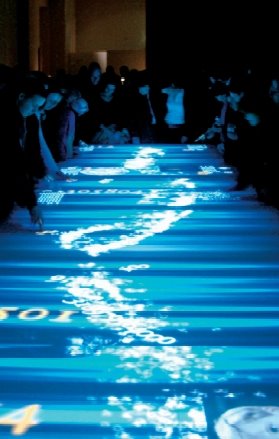
Interactive Tabletop Museum Exhibits

In the most recent issue of IEEE Computer Graphics and Applications, there is an interesting article titled "Interactive Tabletop Exhibits in Museums and Galleries."

From the article:

"The museum experience is an unusually tactile, sensual one, and the standard keyboard-mouse-and-screen setup might seem out of place. This trend toward sensual involvement is particularly noticeable in tabletop displays, as they appeal to two aspects of familiar daily life: the horizontal surface as a workspace, and hand gestures (or common objects) as tools for manipulating information."
The full article can be viewed online (PDF). Readers should notice that the article contains a nice sampling of various interactive/tabletop exhibits. The Tilty Table, in particular, demonstrates that interactivity and intuitive access can (and should) be combined in the museum experience. A sample video is available (MOV).

Tuesday, September 12, 2006

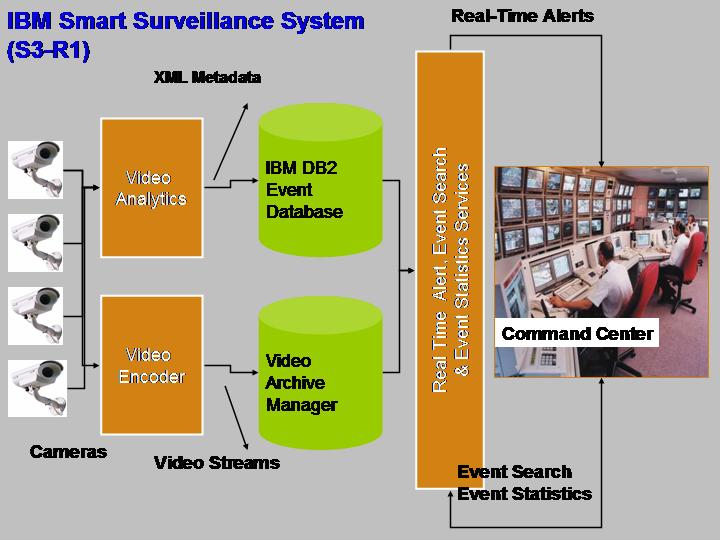
Smart Video Surveillance

The Journal News has conducted an interview with Arun Hampapur manager of IBM's Exploratory Computer Vision Group. The focus is mainly on how the 9/11/2001 attacks changed their research focus in computer vision.

From the Interview:

"Q:How did 9/11 affect your field?
A:Pre-9/11, the success stories in computer vision were around machine vision: How you inspect a printed circuit board while it is being manufactured. Now the biggest application of computer vision would be security. And there are two pieces to that security puzzle. Biometrics is answering the question, 'Who is this person?' Surveillance is answering the question, 'What is going on?'

Q:How does it work?
A:You can apply two kinds of functionality. One I called real-time alerts. You have a port and you have a fence, you don't want anyone jumping the fence. Or you have a retail store with a loading dock, and you don't want anyone on the loading dock past 9 o'clock. These are known conditions, for which you can say, 'OK, so if someone shows up on the loading dock after 9, tell me.'The second is being able to find things. Security is a kind of a cat-mouse game. Sometimes something becomes relevant only after the fact. If you remember the Washington sniper incident, somebody said there was a white van at the first scene, and then the police spent a lot of energy trying to look for the white van. There was no technology at that time which could use cameras to find white vans."
An overview (PDF) of this work has been published in IEEE Transactions on Signal Processing.

Friday, September 08, 2006

3D Photo Tours

With all the recent web coverage of Microsoft Photosynth, I thought that I should post some of its foundational work here.

From the paper:

"Our system consists of an image-based modeling front end, which automatically computes the viewpoint of each photograph as well as a sparse 3D model of the scene and image to model correspondences. Our photo navigation tool uses image-based rendering techniques to smoothly transition between photographs, while also enabling full 3D navigation and exploration of the set of images and world geometry, along with auxiliary information such as overhead maps. We demonstrate our system on several large personal photo collections as well as images gathered from photo sharing Web sites on the Internet."
From a computer vision standpoint, they claim to be using a modified SIFT for wide-baseline matching. While this does not appear to be revolutionary results, it should be understood that, in this case, presentation is everything. This work appears to have a very intuitive interface that could revolutionize image search/retrieval/browsing. Check out this Interactive Demo of a trimmed-down version. Also, here is a nice video (120MB MOV) from SIGGRAPH.

Full Paper (PDF)

Wednesday, September 06, 2006

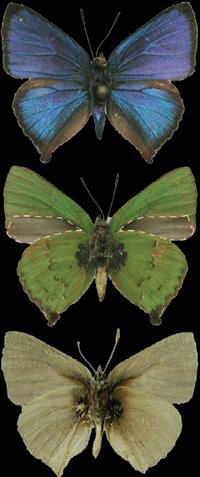
Organic Pixels from Butterflies

While this falls outside the normal areas covered here, it does appear to be some rather fascinating work. Besides, what good is work in graphics without a good display.

From the article:

"The wings of the male Cyanophrys remus are bright metallic blue on one side, thought to attract mates, and a dull green on the other to act as camouflage. ...each side of the wing contained different photonic structures. The metallic blue colour is produced by scales that are photonic single crystals whereas the dull green is the result of a random arrangement of photonic crystals. This randomly arranged structure may have powerful applications. The crystals can actually produce different colours – green, yellow and blue – depending on their orientation, but the overall effect in Cyanophrys remus is a dull green. The team also found a way to make the crystals generate red reflections. The red-green-blue palette could be used for flat-panel visual displays... by making an array of crystals mounted on microelectromechanical arms that could change their orientation. In that way it would be possible for each 'pixel' to produce red, green or blue."
From an outsiders perspective, this is quite amazing. I will leave those more versed in the area to make observations about how novel/unique this work is. The results, published in Physical Review E, can be found in this paper (PDF).